With lawn turf, you can enjoy lush landscaping in days instead of months. The mature grass starts to send roots into the soil almost immediately, standing up better to hot and arid climates.
Turf costs more than grass seed, but by performing the installation yourself, you can save money. Learn how to lay a new lawn from turf with our 7 Steps on How to Lay Lawn Turf.
An attractive lawn enhances your home’s appearance and value, giving you the perfect place for family memories. Laying a new lawn from turf can be challenging, but Seasol turf care products help you create the ideal conditions for great results. Discover high-quality lawn products for a picture-perfect yard.
Seek advice from a local lawn specialist or garden centre to choose the right variety for your garden. For information on lawns varieties check out our understanding lawn varieties guide.


Step 1 – Planning your Lawn.
When considering a new lawn turf, evaluate the area where you want to put your new lawn turf.
Look at:
- Aspect: How much sun or shade does the area get and will it support the type of lawn you want to grow?
- Maintenance: Do you need to prune overhanging trees to ensure the lawn gets enough sun?
- Mowing and Watering: How easy is it to mow or irrigate the area and does it need lawn irrigation installed?
- Drainage: Does water drain away easily when it rains, or do you need to add extra drainage?
- Laying Turf: How long it will take from ordering your lawn to laying it? Turf should be laid on the day or within 24 hours of arrival for best results.
Measuring Lawn
One of the most common mistakes with DIY lawn turf projects is underestimating how much material you need.
To avoid running out of turf, measure your lawn carefully (at least twice). Consider asking a friend or family member to help to ensure your measurements are correct.
- The measuring process.
Many landscaping professionals use a measuring wheel to accurately gauge the length and width of lawn areas. You simply set the wheel down and walk to the endpoint for each measurement.
If you have another person helping — and your yard isn’t too large — a measuring tape works, too.
Some people calculate lawn size by counting out footsteps, but we only recommend this for rough estimates.
- Calculating square metres.
For square or rectangular lawns, calculating the total area is relatively easy. Simply multiply the length by the width. For example, a yard that is 200 m long and 100 m wide has 2000 total sqm (200 x 100 = 2,000).
To measure irregular lawns, you need to do your best to divide the area into rectangles. Measure each rectangle separately and add the totals together.
For triangular portions, follow the same process as rectangular sections, but divide the results in half.
For curved or oddly shaped areas, use a 1 m grid-based approach. First, measure all the filled 1 m squares (12 squares = 12 sqm). Next, estimate the number of partially filled squares on the edges. Count partially filled squares as 1/3 or 1/2 metres each (18 squares = 6 or 8 sqm).
Ordering turf.
Speciality lawn centres, hardware and garden centres generally sell lawn turf. They will also be able to guide you on laying the right turf for your area and climate.
For a 500 sqm lawn, you need a minimum of 500 rolls or around 10 pallets. We recommend ordering 5% more than your total measurements, to give you leeway for cutting, patching or mistakes.
Lawn supply stores usually offer next-day turf delivery. Keep in mind your physical capabilities when ordering turf. It can take a professional landscaping team (three or four people) all day to complete 2,000 square metres of lawn.
If you’re working alone, tackle large lawn projects over several days. Schedule fresh turf deliveries for each morning.
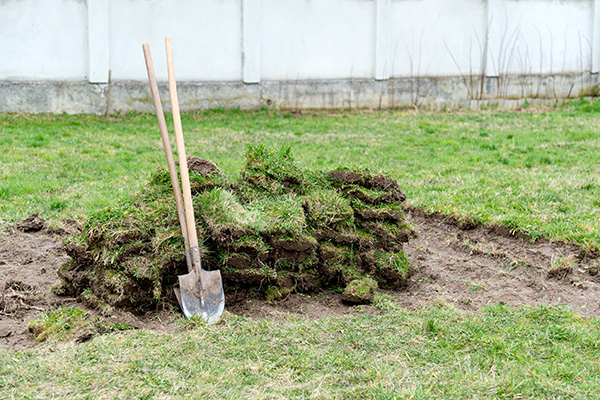

Step 2. Clearing the Ground.
To enjoy problem-free installation of lawn turf, it’s important to have a level, clean surface of bare soil. The steps required depend on whether you’re starting a brand-new lawn or replacing an old one.
- Getting rid of debris.
First, remove as much debris from the yard as possible. Use a wheelbarrow or bucket to dispose of branches, large rocks, construction materials or litter.
If you use a rototiller to aerate the soil, make sure to re-check for boulders or roots afterwards. Clearing away debris helps make your topsoil soft and supportive for turf roots.
- Removing existing grass.
Before laying new turf, you have to remove any existing grass. This includes thatch, dead grass and even healthy portions of lawn. For turf to look seamless and level, it needs a completely bare dirt surface underneath.
It’s technically possible to get rid of old grass with a shovel and wheelbarrow, but only use this method if you need to keep costs to a minimum. Digging up a large lawn by hand is time-consuming and tiring.
Hiring or buying a turf cutter is a much easier option. A cutter looks similar to a mower or rototiller. It automatically turns the top layer of your yard into narrow strips of turf that are easy to manage.
Pro tip: Use a garden knife to cut turf into manageable portions for disposal. Toss them into a wheelbarrow or use heavy refuse bags.
- Eliminating weeds.
Turf cutters take care of weeds at the same time as old grass, so if you go that route, your lawn project is ready for the next step.
Things are different if you’re laying lawn turf over bare soil for a new home. This includes landscaping or home improvement projects, such as installing underground pipes or planting trees. Weeds grow quickly in bare soil.
These freeloaders are a headache for healthy turf because they compete for water and nutrients.
If there aren’t many weeds, feel free to save money by pulling them out by hand (and tossing them away).
For moderate weed growth, apply a non-toxic weed killer, such as fast-acting Earthcare Organic WeedKiller spray. The advantage of organic weedkiller is that the ingredients break down naturally in the soil, leaving no harmful residues behind.


Step 3 – Improving the Soil
Even though lawn turf consists of healthy grass, it still needs proper care to become a long-lasting and lush yard. Good soil preparation is essential.
This stage is also the ideal time to perform any tasks involving digging, such as installing a watering system or grading the yard for better drainage.
- Checking soil pH.
Soil testing kits are easy to use and relatively inexpensive, only requiring you to add some soil and water, shake and wait. Aim for a slightly acidic (6.0) to neutral pH (7.0).
If your soil tests too alkaline (7.5), amend it with organic matter or homemade compost and/or Seasol Super Compost.
Correcting overly acidic soil (5.5 or lower) is more complex. It requires adding dolomitic lime and tilling the ground. Wait 30 to 45 days before planting to give the lime time to work.
- Correcting poor soils.
The composition of your soil matters for long-term lawn health, too.
- Clay soils: Can cause drainage problems, impede root growth and elevate ground temperatures. There are two solutions: add a layer of sand or mix the clay with organic matter, homemade compost and/or Seasol Super Compost. It creates an optimal growing environment for lawn turf, combining high-quality ingredients, nutrients, good microbes and trace minerals. Both options make it easier for roots to grow.
- Sandy soils: Too much sand isn’t good for turf, either. Overly sandy soils lose moisture quickly and don’t provide enough nutrients. Use plenty of organic matter to amend this type of soil, as described above and apply Seasol Liquid Compost hose-on to help improve the soil. This fast-acting liquid compost requires no-digging and goes to work immediately to improve soil health.
- Tilling.
In many parts of Australia, arid weather and excessive heat lead to dry and compacted soil. The dirt can even develop a hard crust. These conditions don’t support healthy lawn turf.
If your budget allows, hiring a tiller is one of the best investments you can make.
Rototillers dig deep into the ground, automatically breaking up dry soil and softening the earth. You can also use the tiller to mix amendments into the soil, including compost and sand.
Water the soil thoroughly a day or two before tilling to ensure water is going down into the soil. If water is pooling on top or running off, applying Seasol Super Soil Wetter & Conditioner will help to ensure water stays within the soil.
Moist soil breaks up into finer particles, encourages root growth and helps with levelling.
- Adding topsoil.
Lawn roots can grow to a depth of 2 m or more, so your overall soil quality matters. That said, the most important layer for initial growth is the topsoil.
The first 15 to 20 cm of soil should be a high-quality mixture of organic matter, clean earth and nutrients.
Amending your lawn can create this type of soil, but if you’re looking for a shortcut, you can also use Seasol Lawn Top Dress Mix. It has excellent ingredients, fertilisers and wetting agents to promote lush turf.


Step 4 – Leveling the ground.
Once you’ve finished tilling and amending the soil, you need to create a level surface. Use a garden rake, bow rake or drag mat to spread out the dirt, removing peaks and filling in valleys.
Afterwards, compress the soil softly with a lawn roller.
When you finish, the soil level should be 30 mm to 40mm below any landscaping edges, such as concrete patios, driveways, footpaths, garden edging or sprinkler heads to allow for the thickness of the turf.
That way, when you lay lawn turf, the grass fits seamlessly into place.
Once level, pre-water the soil in preparation for laying the turf. Check that water is going down into the soil and reapply Seasol Super Soil Wetter & Conditioner hose-on if required. It contains a wetting agent and soil conditioners to help water penetrate heavy soils by improving water-holding capacity and nutrient uptake for sandy soils.
Step 5 – Laying lawn turf
- Handing lawn turf
Work with one roll of turf at a time, positioning one end in place and unrolling it completely.
Don’t walk on the turf as you adjust it. Do pat it lightly with your hand to remove any air pockets, though.
Stagger the seams in a bricklaying pattern, with rolls ending halfway past the neighbouring piece. This layout helps to hide seams and create better adhesion for the lawn.
To create a staggered arrangement, place the first piece of turf whole. Cut the second in half (crosswise) using a garden knife, utility knife or carpet knife.
Put the half piece beside the first one. For the third piece, use a whole roll again and repeat this alternating pattern for the width of the space.
- Creating straight edges when laying
This makes it easier to create a lawn that looks beautifully aligned from start to finish.
Small scraps are more vulnerable to drying out or sliding, so you should never put them on the outside. In the middle of the lawn, they receive more water, nutrients and protection.
- Laying the rest of the lawn
Each strip of turf should fit snugly next to its neighbour. Be careful not to overlap or crush grass, but make the seams as tight as possible.
When you’re finished, there shouldn’t be any bare soil visible. Otherwise, weeds can take root.
Some landscapers add a little potting soil at the seams to enhance moisture retention and avoid heat damage.
- Slopes
To lower the risk of nutrient loss or sliding, place turf horizontally instead of vertically on sloped areas. This limits the amount of weight pushing downwards.
- Slopes
Depending on the incline, you may need to use landscape staples or circle pins to provide extra support.
Keep turf staples in place for a few weeks to allow the lawn to lay firm roots.
- Trees and curves.
Curved sections of turf are trickier to install, but you can get good results with your trusty garden knife.
- Trees and curves.
For trees or other round penetrations, use partial sections of turf. Place the turf against the tree so it rides up the side. Wrap a plastic tube or hose around the base tree and use it as a guide to cut the turf smoothly.
.


Step 6 – Rolling and watering the lawn
Once you’ve finished laying the lawn turf (or the section for the day), use a manual lawn roller to gently tamp down the pieces. Good soil contact is a must for healthy turf, as it promotes root growth.
Hand-operated lawn rollers are relatively affordable and they help with the soil-leveling process, so they’re a good investment for DIY landscaping projects.
Apply Seasol Lawn & Turf Starter hose-on to help reduce transplant shock and aid lawn establishment. It also helps to promote strong root development and healthy growth. Reapply every week during the first six weeks to keep the lawn and roots growing strong and healthy and to aid lawn establishment.
Follow a regular, deep watering schedule with newly installed turf. The moisture is critical to prevent drying out or overheating — especially in arid regions — but you also want the turf to send out roots in search of moisture.
During the first week after laying lawn turf, water twice a day for 10 to 15 minutes. The soil should be damp, but not wet or muddy. It’s alright to lift a corner of turf to check the soil’s moisture level until you get the hang of things.
During week two, give the lawn moisture every other day. Your local weather should determine how long you water. If it rains, skip watering for a day.
In week three, start watering two or three times a week. By week four, you can lower your watering schedule to once a week or so. Aim to keep the top 3 to 5 cm of soil moist.
Step 7 – Caring for your lawn.
Minimise foot traffic for at least four weeks after laying turf. This includes keeping pets off the new lawn. Wait two or three months before inviting friends over for backyard parties.
- Cutting grass.
How long should you wait before mowing lawn turf? Mowing too early puts stress on the roots, but waiting too long can prevent grass from growing lushly.
As a rule of thumb, wait at least 10 days before taking out your walk-behind mower (no riding mowers for several months). The grass should be 7 or 8 cm long.
Perform a pull test before mowing. If you feel the turf section coming up, don’t mow yet. Bag any clippings after mowing. New blades of grass should get plenty of sunlight.
- Fertilising.
If you’re using Seasol Lawn and Turf Starter, apply the product once a week for six weeks. This intensive treatment provides all the extra nutrition your new turf requires.
Afterwards, we recommend using Seasol for Lush Green Lawns once a month to strengthen and feed new grass to help them cope with heat, cold, and foot traffic and promote lush growth. Safe on all lawn types including buffalo. For a specialised buffalo formula for a wider leaf blade use Seasol for Buffalo Lawns.
For more lawn tips, check out our seasonal lawn care guide.