Tibouchina (Tibouchina spp.)
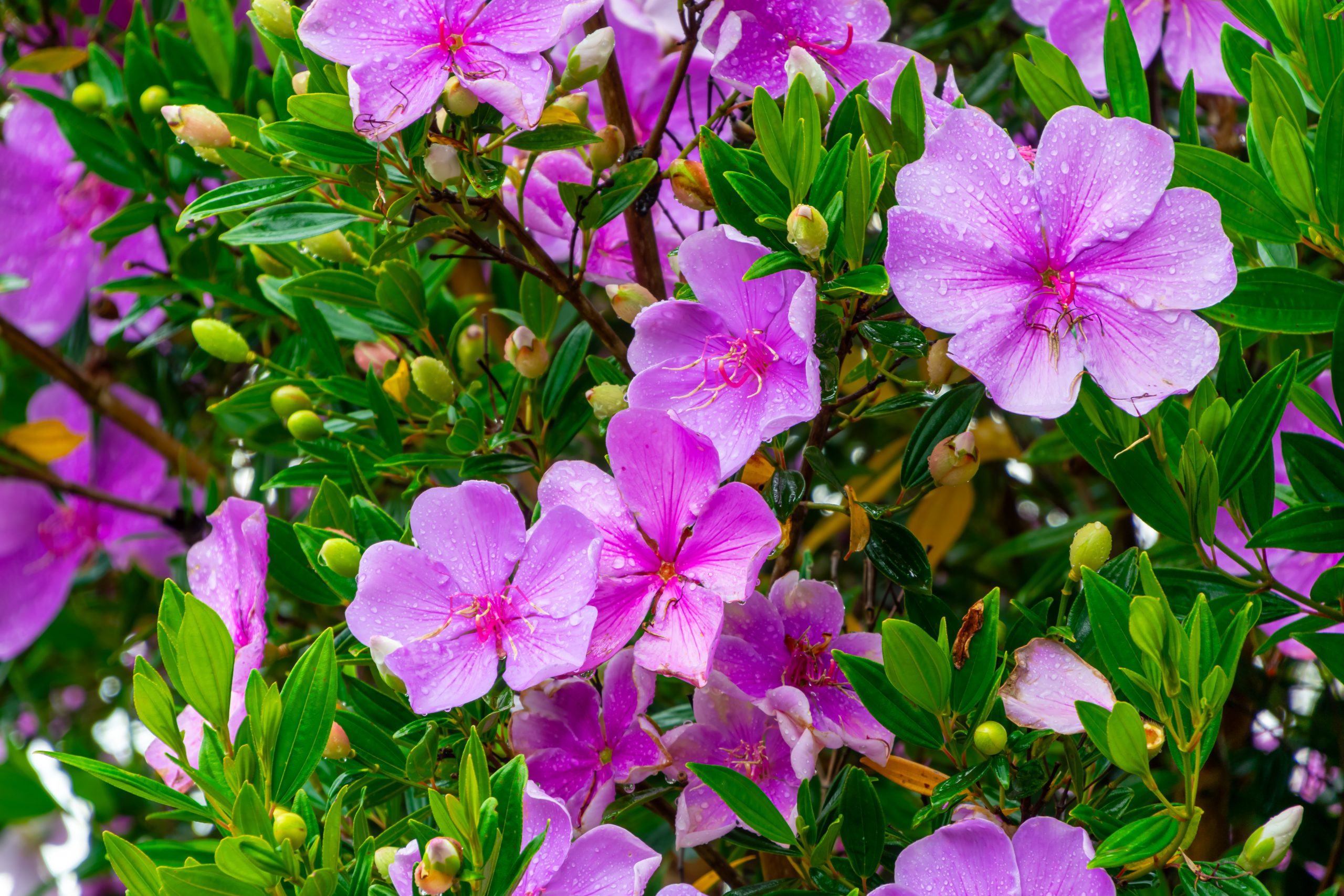
Tibouchina, also known as lasiandra, is an eye-catching purple-flowering shrub that fills many gardens with colour in autumn and early winter.
They are evergreen shrubs or small trees 4 to 8 metres tall with velvet green leaves, native to the tropical climate of Brazil. While tall-growing varieties are seen in many gardens, dwarf varieties introduced to gardeners in recent years are being used in small gardens, containers, and courtyards.
Although purple is the main colour associated with tibouchinas, there are also plants with white, pink, and bicolour of white and pink flowers, or flowers that change from purple to white via pink to give the bush a confetti look.
To grow a tibouchina as a small tree, prune to form a canopy above head height for everyone to admire.
There are many varieties of tibouchina available, from dwarf plants to large shrubs and small trees. Check with your hardware or garden centre for a variety that will suit your local environment. Here are a few to consider:
- Dwarf varieties
- ‘Groovy Baby’ is one of the compact forms of tibouchina growing to 45cms in height and is ideal for pots and containers. It has electric blue flowers which make it ideal for entertaining areas during the warmer months.
- ‘Jules’ is known as a quick-growing small shrub to one metre tall with a mass of large, rich pink-purple flowers in the warmer months. Ideal as a low-hedge, feature plant or in a pot on a patio or deck.
- ‘Jazzie’ paired with ‘Jules in a pot, these two varieties enhance each other. By itself, it is a compact shrub to 1 metre tall in a pot or 2 to 3 metres tall in the ground in its ideal location of a sub-tropical area. It has vibrant cherry-red buds and rich purple blooms in autumn.
- ‘Peace Baby’ is a small, compact shrub growing to 1 metre tall. It has striking velvet foliage paired with abundant large, white flowers from late spring to autumn. It is ideal to add to a pot in a grouping with other tibouchinas.
- ‘Foxxy Baby’ grows to 1 metre tall and is great for pots, mass planted in borders or used in rockeries and gardens. It is stunningly different with profuse bi-coloured flowers in pale pink and white with purple statements. With evergreen velvet green leaves, it is a hardy, fast-growing plant.
- Larger shrubs to small trees
- ‘Alstonville’ is quick to establish as an evergreen impressive small tree to large shrub growing to 5 metres tall and 4 metres wide. In bloom, it has a mass of rich, dark purple flowers in winter. In warmer regions, it has longer, more slender leaves than other varieties.
- ‘Granulosa’ is a large, sprawling small tree growing up to 8 metres tall. One of the taller varieties of tibouchina, it has showy deep rose to violet flowers and lush, dark green foliage as its backdrop.
- ‘Kathleen’ grows as a small tree or large shrub to 6 metres high and 5 metres wide. Preferring a warm, sheltered garden, it has stunning purple flowers in autumn.
Growing conditions
Aspect All tibouchinas need a bright, sunny location for good flowering however, as tibouchinas are frost and cold sensitive, they also need protection from frost. They grow in partly shaded conditions but will produce fewer flowers and have more lanky growth.
Soil Best with well-drained, fertile soil. Before planting add home-made compost and organic matter and/or Seasol Super Compost. If planting into a pot use a large container with a premium potting mix such as Seasol Advanced Potting Mix.
Climate Tibouchinas grow across all but the coldest climates. They are seen at their best in subtropical climates. Plants tolerate or survive light frost but may be killed outright by heavy frost.

General care
Watering Water regularly to establish, but once established, plants are drought tolerant. Containerised plants need regular watering.
If water is pooling on top of the soil or running down the insides of the pots, it may be repelling water. Apply a soil wetter such as Seasol Super Soil Wetter and Conditioner.
Feeding and mulching Tibouchina like to be fed from spring as new growth appears, through to the last flowers in autumn. Feed with a fertiliser for flowering plants such as Seasol plus Nutrients Roses & Flowers. Supplement this with a liquid fertiliser such as PowerFeed PRO SERIES for Roses & Flowers every two to four weeks.
Use organic mulch around trees and shrubs such as leaf litter, bark mulch, sugarcane mulch, lucerne or pea straw to keep plants free of weeds.
Pruning Prune after flowering. To regenerate tall, lanky plants prune by a third, wait for strong, new growth, then prune again during early and mid-summer.
Watch out Tibouchina has a few pest or disease problems, but occasionally it will get attacked by spider mites, aphids or scale. Prune off damaged and diseased foliage and spray with natural EarthCare White Oil insect spray. Remember to spray both sides of the foliage when beneficial insects are not around. Repeat spraying may be required depending on the pest and level of infestation.