Ornamental or callery pear (Pyrus calleryana)
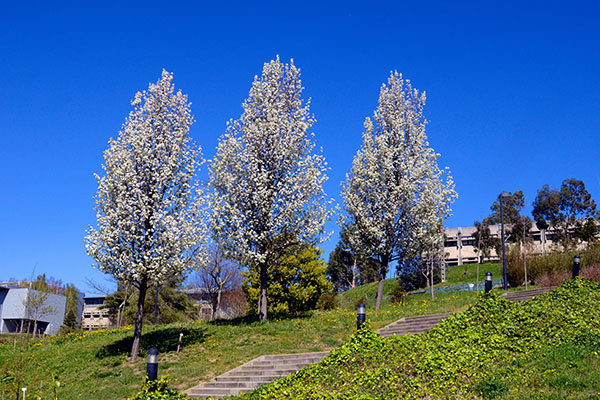
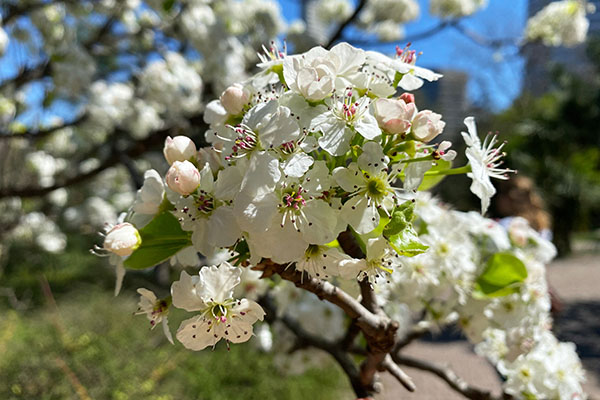
Ornamental/ callery pear is an excellent deciduous tree for a cool temperate garden. It is grown as a feature or avenue tree eventually reaching up to 10m or more in size with clusters of white spring flowers. Its small, dark green slightly wavy leaves colour in autumn in tones ranging from yellow and orange to red. Although not grown for fruit, ornamental pears may produce small, hard, brown fruits after flowering.
Native to China and Vietnam, ornamental pears are now grown in gardens, parks and streets around the world. Much of the work developing cultivars for landscape planting has been carried out in the US. In some parts of the US the tree is now considered invasive. Ornamental pear is a member of the rose family (Rosaceae).
There are many named varieties of ornamental pear, so check out your local hardware or garden centre for varieties that suit your climate. Here are a few to consider.
- ‘Capital’ is one of the narrowest, which grows around 11m high but is just 3m wide. It is often selected for street tree planting or to line a driveway.
- ‘Aristocrat’ is a popular variety which is a broader more conical tree with good branch structure. It is suited to large gardens and park plantings. Expect trees to grow 11m x 7m.
- ‘Chanticleer’ is grown for its elegant, pyramidal shape. It can be used as a street tree or grown as a feature tree in a garden or park. Expect trees to grow 11m x 6m.
- ‘Bradford’ is one of the oldest cultivars. This tree forms a broad, conical shape over time. Expect trees to grow 12m x 9m.
Growing conditions
Aspect Ornamental pear needs a bright, sunny location. It will grow in lightly shaded conditions. To make the most of its spring flower display, select a position that’s sheltered from strong wind. Flowering can be brief but spectacular.
Soil Adaptable to a wide range of soils (which is why some varieties are grown as street trees) but fastest growth is seen in situations with deep, rich, well-drained soil. Before planting add home-made compost and organic matter and/or Seasol Super Compost. Check the soil beneath the tree every season and remove weeds.
Climate Ornamental pears prefer a cool temperate climate. The trees are frost and cold tolerant. Established trees will cope with heat.
General care
Watering Water regularly especially when establishing and through summer or in prolonged dry periods to encourage good growth.
Feeding and mulching Ornamental pears can be fed via your preferred method, either liquid or granular food or a combination of both. Keep plants growing well with a granular fertiliser such as Seasol plus Nutrients All Purpose including Natives every 6 to 8 weeks during the growing season. Spread under the drip line of the tree (the area at the edge of the foliage canopy) as this is where the feeder roots are located. Remember to water it in thoroughly after application. If you prefer liquid feeding, apply PowerFeed All Purpose including Natives every 2 to 4 weeks during the growing season, around the drip line of the tree’s canopy.
Mulch with organic mulch such as leaf mulch (keep mulches away from the tree trunk).
Pruning Naturally elegant with a central leader. Little pruning is needed except for general maintenance such as removing dead or damaged branches.
Watch out This plant has few pest or disease problems but may be attacked by pear and cherry slug. Some branches can be thorny. Small fruits can be a nuisance in summer or autumn when it falls but are easily swept or raked up. The fruit may also be eaten by birds late in the season.